
Common house spider
Harmless: this is the small brownish cobweb spider found in corners and window frames, and it almost never bites.
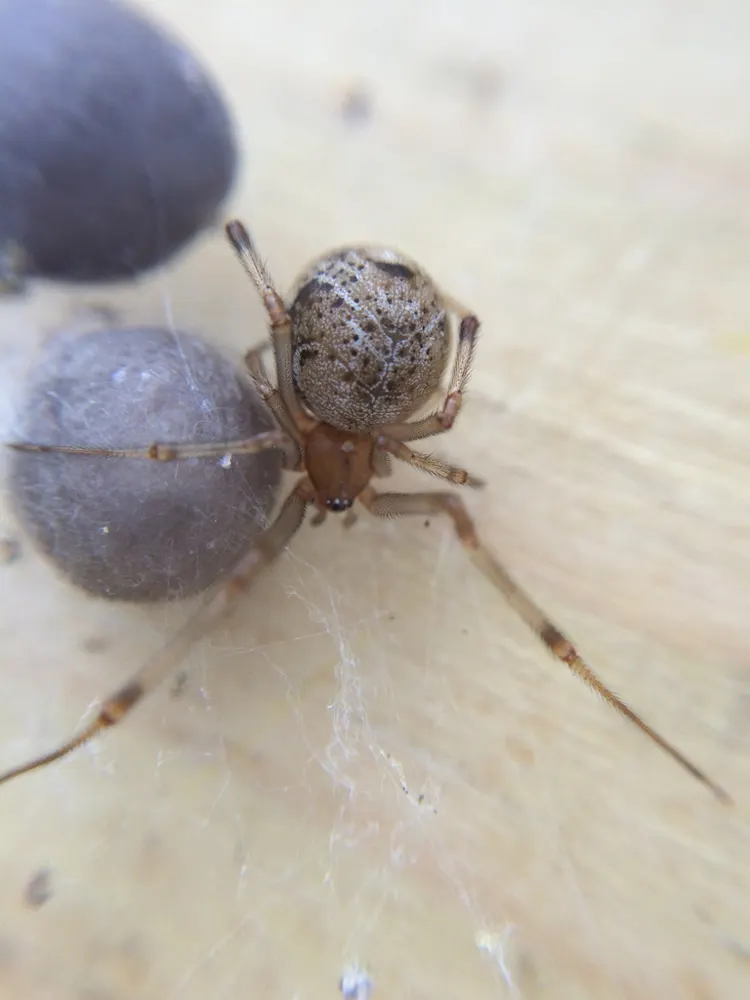
Check these features
- Round, high, teardrop-shaped abdomen in mottled gray, tan and brown
- Faint chevrons and a small pale spot near the top of the abdomen
- Yellow-brown legs with darker bands
- Hangs upside down in a messy tangle web in a corner or window frame
- Brown, pear-shaped egg sacs hanging in the web
Bites and stings
Very rarely bites; it retreats when disturbed. The few known bites usually caused little or no reaction. As with any bite, get medical advice if you see spreading redness, signs of infection, or an allergic reaction.
What to do
- No danger to worry about: leave it, or remove it and its web.
- Vacuum the spider, web and egg sacs if you want it gone.
- To relocate one, trap it under a cup with a card and release it outside.
- If cobwebs keep coming back, reduce outdoor lights that draw insects near windows and doors.
Look-alikes
Why it came inside
It lives on and in buildings, building webs in quiet corners, window frames and eaves where lights and walls bring it a steady supply of small insects.
Keep it out
- Vacuum corners, window frames and ceiling edges regularly, including egg sacs.
- Seal gaps around windows, doors, pipes and wires with caulk.
- Keep screens in good repair and add door sweeps and weatherstripping.
- Use yellow or sodium-vapor style bulbs or keep outdoor lights off to draw fewer insects.
What helps
Links go to Amazon search results so you can compare current options. As an Amazon Associate I earn from qualifying purchases. Always follow the product label.
Lets you remove bugs, webs and egg sacs without touching them. Empty the bag or canister outside right away.
See options on AmazonSilicone or siliconized acrylic caulk closes cracks around windows, pipes and baseboards. Bigger gaps need foam backer rod or expanding foam first.
See options on AmazonPatches or replaces torn window and door screens, one of the most common ways insects get in.
See options on AmazonCloses the gap under an exterior door. If you can see daylight under the door, bugs can get in.
See options on AmazonSeals the gaps around doors and windows that let in drafts and bugs alike.
See options on AmazonFlat glue traps set along walls and in corners show what is moving through and where. Place them where pets and children can't reach.
See options on AmazonSources
- University of Florida IFAS (Featured Creatures / EDIS)
- Colorado State University, Dept. of Agricultural Biology
- UC Statewide IPM Program
- University of Minnesota Extension
Checked October 18, 2026. Rating backed by 3 sources. How we rate danger.