
Brown widow
Brown widow bites are usually much milder than black widow bites, but it is a true widow and easy to confuse with a young black widow, so get medical advice after a bite.
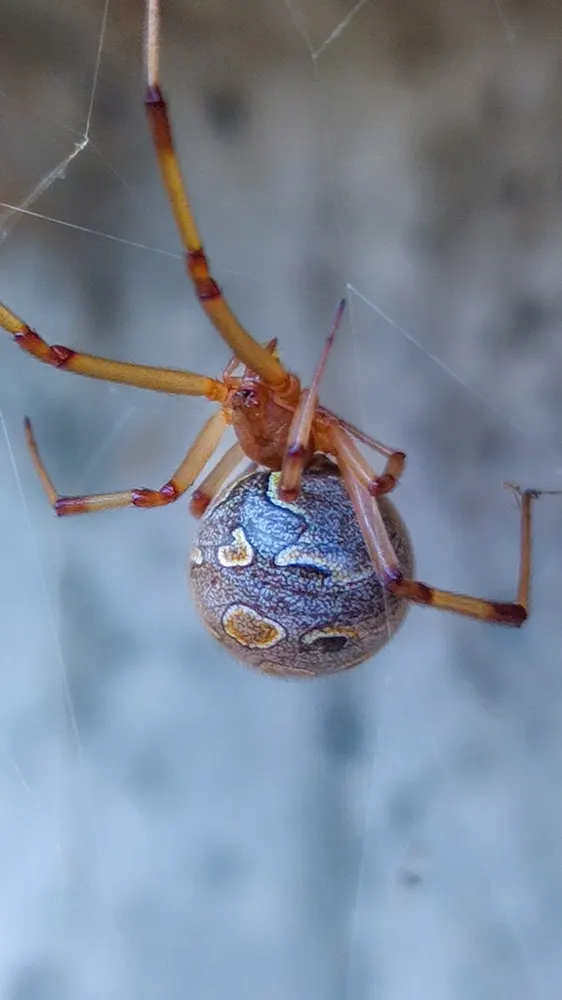
Check these features
- Mottled tan, brown or gray body (some are nearly black) with a black-and-white geometric pattern on the abdomen
- Orange to yellow-orange hourglass on the underside, rather than bright red
- Dark bands on the legs
- Egg sac is round and covered in small pointed silk spikes, like a burr or a pollen grain
- Webs in exposed sheltered spots: under eaves, railings, outdoor chairs, recessed trash can handles, mailboxes
Bites and stings
Brown widows are timid and rarely bite; most known bites caused pain at the bite and a red mark that faded. A small number of people have had stronger widow-type symptoms such as spreading pain and cramps, and one verified US case needed hospital care. Get medical advice after any bite, and seek care promptly for spreading pain, cramps, sweating or nausea, or if the person is a young child, older adult or pregnant.
What to do
- Move away from the spider, then wash the bite with soap and water and apply a cool, damp cloth or wrapped ice.
- Call Poison Help at 1-800-222-1222 (US, free, any hour) for advice on what to do next.
- Call 911 for trouble breathing, swelling of the face or throat, or severe symptoms such as spreading pain or strong muscle cramps.
- If it is safe, photograph the spider and any egg sacs nearby; the spiky egg sac helps confirm a brown widow.
- Do not cut the bite or try to remove venom.
Look-alikes
Why it came inside
It is mainly an outdoor spider of yards, patios and buildings in towns and cities, and it is rarely found inside living spaces; it does move into garages, storage areas and entryways.
Keep it out
- Check under outdoor furniture, railings, mailboxes, plant pots, buckets and trash can handles, and wear gloves when cleaning these areas.
- Remove clutter and unused containers from patios, porches and garages.
- Vacuum or knock down webs and spiky egg sacs regularly; seal and discard the vacuum bag outdoors.
- Seal gaps around doors and windows and keep screens in good repair.
- Do not relocate brown widows outdoors elsewhere; they are an invasive species.
What helps
Links go to Amazon search results so you can compare current options. As an Amazon Associate I earn from qualifying purchases. Always follow the product label.
Lets you remove bugs, webs and egg sacs without touching them. Empty the bag or canister outside right away.
See options on AmazonFlat glue traps set along walls and in corners show what is moving through and where. Place them where pets and children can't reach.
See options on AmazonCloses the gap under an exterior door. If you can see daylight under the door, bugs can get in.
See options on AmazonSilicone or siliconized acrylic caulk closes cracks around windows, pipes and baseboards. Bigger gaps need foam backer rod or expanding foam first.
See options on AmazonPatches or replaces torn window and door screens, one of the most common ways insects get in.
See options on AmazonA long-handled catcher moves a spider or insect outside without you having to touch it.
See options on AmazonScorpions glow under ultraviolet light, which makes them much easier to spot at night.
See options on AmazonSources
- University of California IPM
- UC Riverside Center for Invasive Species Research
- Clemson Cooperative Extension (HGIC)
- UC Riverside (UC IPM Green Bulletin reprint)
- Clemson Cooperative Extension (HGIC)
- New Mexico State University
Checked October 18, 2026. Rating backed by 3 sources. How we rate danger.